Period: 1945 – present
It is the only epoch we ourselves are still standing in. No final line divides it from us — its last sentence is being written today, and tomorrow, and the day after.
The Age of Those Still Living
Every epoch of history has a beginning and an end. Antiquity fades with Rome, the Middle Ages give way to the Renaissance, the early modern age flows into the modern. Only one knows no full stop: contemporary history. It begins in 1945, amid the rubble of the Second World War — and it has not stopped since.
In 1953 the historian Hans Rothfels found the phrase that still echoes. Contemporary history, he wrote, is the "epoch of those living through it, and its scholarly treatment." An unusual thought: a history of a time whose witnesses still breathe, whose wounds still lie open, whose ending no one knows. Whoever studies contemporary history sits in the very same boat.
That makes it singular — and uncomfortable. For anyone writing about their own present lacks the distance that orders the past. Antiquity can be surveyed like a landscape from a mountaintop. Contemporary history is the road we are still walking — in fog, with no way of knowing where the next bend will lead.
Thirteen Days at the Brink — the Cuban Missile Crisis of 1962
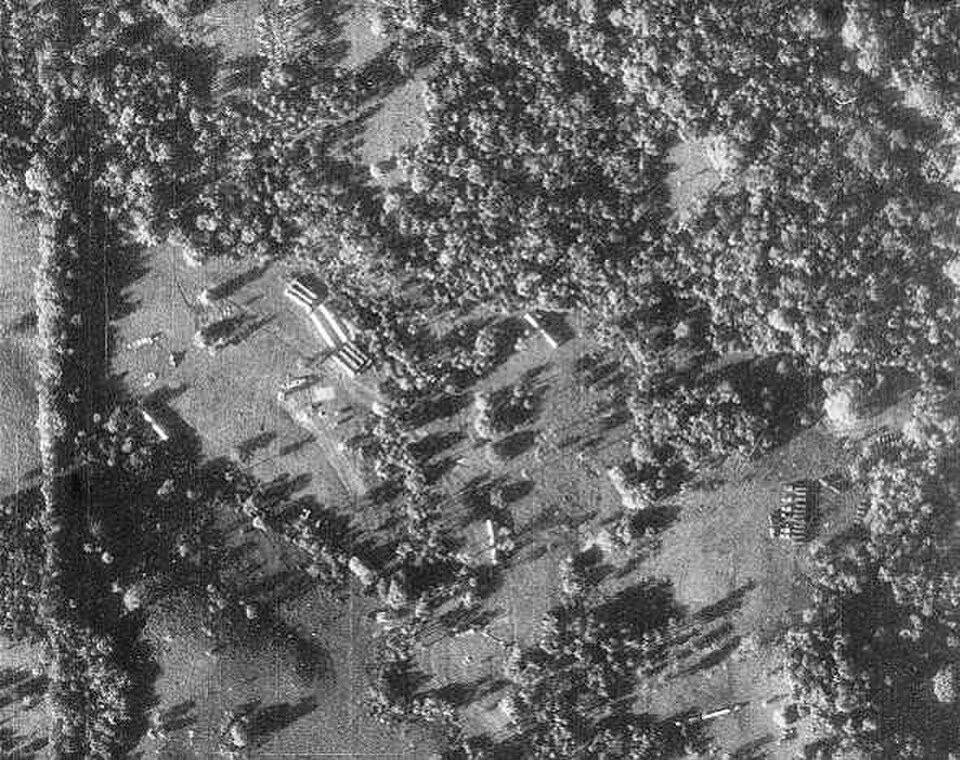
And yet there are moments in which the whole epoch condenses into a single image. October 1962 is one of them.
On the 14th, an American U-2 spy plane photographs what almost no one had thought possible: Soviet launch pads for nuclear missiles on Cuba, barely 150 kilometres from the coast of Florida. From there, half of America could be struck within minutes. In Washington the quietest panic of modern history breaks out.
For thirteen days the world stands at the edge. President John F. Kennedy throws a naval blockade around Cuba — a "quarantine," as he calls it in a television address on 22 October. Soviet freighters draw closer to the invisible line. A single error, one officer too tense, one misread signal — and the missiles fly.
The crisis is resolved not with weapons but in secret. In hushed conversations between the president's brother, Robert Kennedy, and the Soviet ambassador Dobrynin, a bargain takes shape: Moscow will withdraw its missiles from Cuba, Washington will pledge not to invade the island — and will quietly dismantle its own nuclear missiles in Turkey. On 28 October the world steps back from the abyss. Soon after, a direct line is strung between the White House and the Kremlin, so that such a moment might never again be born of a mere misunderstanding.
A Divided World
The Cuban crisis was the peak of an order that cut the world in two for four decades. Scarcely had the Second World War ended when an "Iron Curtain" split the continent — here the American-led West, there the Soviet East. No open war between the great powers, but an unending contest of threat, espionage and proxy conflict: the Cold War.
As early as 1948 it showed how quickly it might turn hot. When the Soviet Union cut West Berlin off from all supply, the Western Allies kept the city alive from the air alone for nearly a year — more than a quarter of a million flights, day and night. The airlift became the emblem of an age in which even flour and coal turned into weapons in the struggle of systems.
It was a peace built on fear. Two blocs, armed to the point of being able to erase each other many times over — and precisely that prospect held both in check. The balance of terror, they called it. For decades the world lived beneath a sky under which everything might have ended at any hour.
History Still Being Written
Then, almost imperceptibly, the ground shifted. Not with a bang, but with a hum. Calculating machines — first filling rooms, then fitting on a desk, then vanishing into every pocket — began to rewire the world. What had taken millennia to change now happened in years.
Contemporary history is the first epoch whose pace threatens to outrun the human beings living it. A message that once travelled weeks across oceans now circles the globe in the blink of an eye. Markets, crises, images, ideas — all connected, all at once. Change is no longer an event but a permanent condition. And no one alive today can say where the acceleration leads.
An Epoch Without End
Here lies the true secret of contemporary history. It is not a closed chapter that can be opened and shut. It is a book still being written — and all of us hold the pen.
Today, however ordinary it seems, will one day be contemporary history. Today's newspapers are tomorrow's sources. What is routine to us will puzzle the historians to come — just as the small habits of past ages puzzle us now.
Perhaps that is the faintest yet deepest thought this epoch offers: history is nothing distant. It happens while we live it. We are not merely its readers — we are its witnesses, its actors, its last and still unfinished line.
Test Your Knowledge
Can you guess the historical epoch from four clues? A new puzzle every day — free to play.
Sources: Cuban missile crisis, Britannica (britannica.com) · Cuban Missile Crisis, JFK Presidential Library (jfklibrary.org) · The Cuban Missile Crisis, October 1962, Office of the Historian – U.S. Department of State (history.state.gov) · Berlin blockade, Britannica (britannica.com) · The Berlin Airlift 1948–1949, Office of the Historian (history.state.gov) · Hans Rothfels, Zeitgeschichte als Aufgabe, Vierteljahrshefte für Zeitgeschichte (1953)