Period: c. 1500 – 1800 CE
Two movements at once: inward, the unity of faith broke apart; outward, the earth stretched to its very edges. Rarely has a worldview been rewritten so thoroughly in so few years.
Between Two Worldviews
The early modern era begins not with a date but with a double tremor. Few epochs wear their rupture so openly: around 1500 Europe stood on a threshold, and no one who crossed it could have guessed how far the road would run.
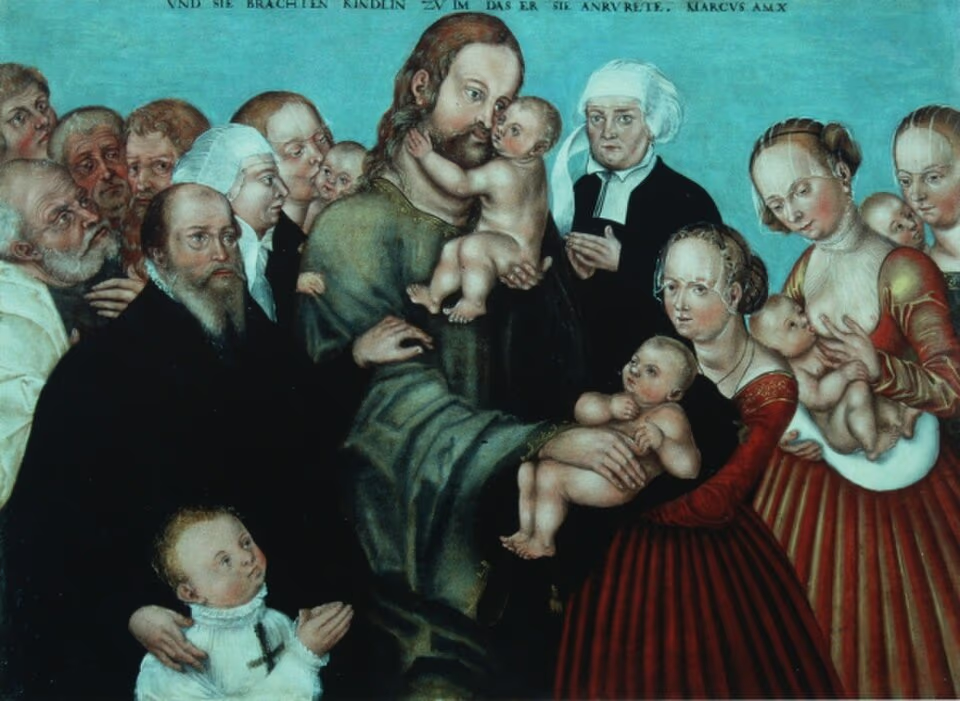
Two movements ran into one another. The first turned inward. For centuries the Latin Church had held the West together like a single vault. Now that vault began to crack, and with it the certainty that there was only one truth — and only one authority to guard it.
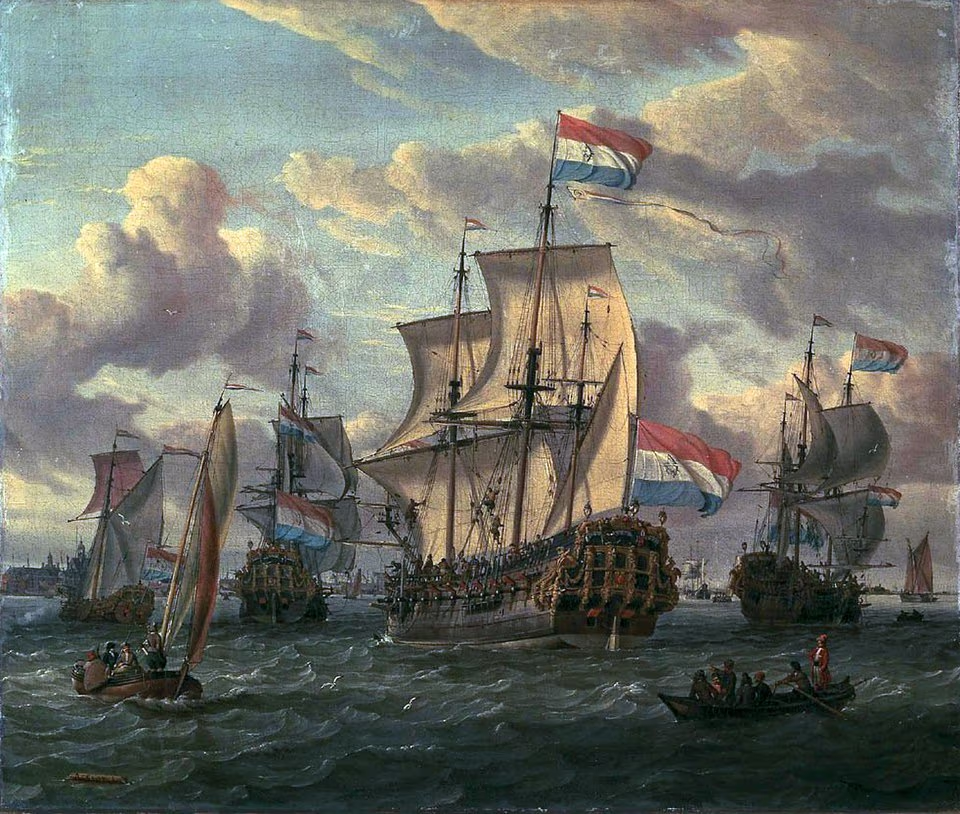
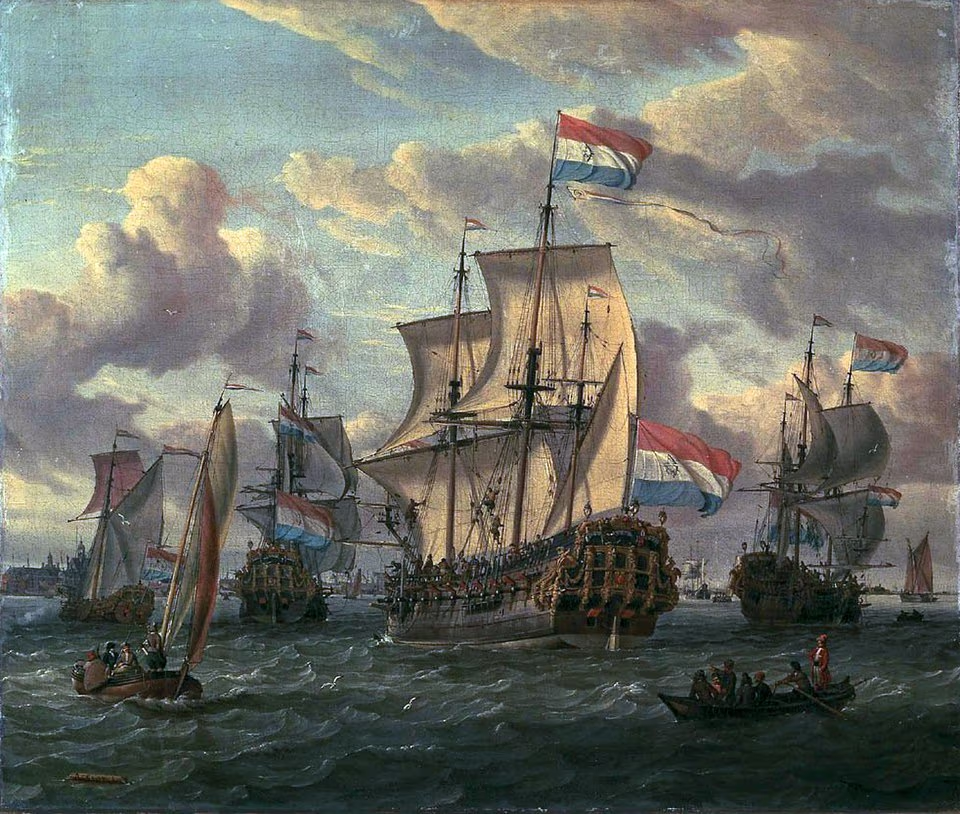
The second movement turned outward. Sailing ships left the harbours of Portugal and Spain and returned with news no map contained. Continents unknown to antiquity rose out of the sea. The earth, until recently surveyable, became all at once immeasurable.
Both happened almost simultaneously, and both struck at the same core: the old order in which everyone had a fixed place and the limits of knowledge coincided with the limits of the known. Between 1500 and 1800 that order dissolved — slowly, through struggle, often in blood. What remained at the end was a world that already looks familiar to us.
The Theses That Split Europe
It all begins with a quarrel over trade in the hereafter. In the years around 1517, preachers of indulgences travelled the German lands offering the faithful a tempting bargain: for money, one could shorten the time spent in purgatory — for oneself, and even for the long-dead. A Dominican named Johann Tetzel is said to have advertised the trade with a catchy little rhyme, and the coins rang as they fell into the chest.
An Augustinian monk and professor of theology in Wittenberg regarded this trade as a fraud upon human fear. Martin Luther drew up ninety-five theses that placed the practice of indulgences up for academic debate. They might have faded away within the narrow walls of a lecture hall.
The image later ages made of it is a mighty one: the defiant monk nailing his theses to the door of the castle church in Wittenberg, on 31 October 1517. Whether that posting ever happened is disputed among historians to this day — much suggests that Luther first simply sent his propositions as a letter to the responsible bishops. The scene with the hammer may have grown up afterwards, a founding image too strong to need to be true.
What mattered was not the door but the press. What had been meant as a scholarly dispute was seized by the printing press and carried across all of Germany within weeks. For the first time, an idea could travel faster than its author. Luther wrote in a clear, forceful German that ordinary people understood, and he wrote ceaselessly — a considerable share of everything printed in German in those years came from his pen.
A quarrel over indulgences became a schism in Western Christianity. The unity of faith that had carried the Middle Ages shattered — and with it the notion that authority was indivisible. It was a fracture that would shape Europe for centuries.
Departure into an Unknown World
While faith was splitting, the earth was widening. On 20 September 1519 a fleet of five ships left the harbour of Sanlúcar de Barrameda: the Trinidad, the San Antonio, the Concepción, the Santiago and the Victoria. Aboard were some 270 men. Their commander was a Portuguese mariner in Spanish service — Ferdinand Magellan, whom the Spanish called Fernando de Magallanes.
Their goal sounds sober: a western sea route to the Spice Islands, the Moluccas, where nutmeg and cloves were worth more than gold. Their journey became legend. For months the fleet felt its way down the coast of South America until Magellan found a narrow, twisting strait that joined the Atlantic to an unknown ocean — the passage that today bears his name. Beyond it lay a sea so calm he christened it Mar Pacífico, the peaceful ocean. It lied. The crossing took nearly a hundred days; the provisions rotted; men died of scurvy.
Magellan himself never saw home again. In April 1521 he was killed on the island of Mactan in the Philippines, ensnared in a foreign war. Command eventually passed to the Basque Juan Sebastián Elcano. Of the five ships only one returned, the small Victoria, and when she reached Spanish soil again in September 1522 there were eighteen wasted men aboard, out of the roughly two hundred and seventy who had set out.
They had done what no one before them had managed: circled the earth. The proof that the world was a sphere could now no longer merely be thought — it could be walked. Yet this departure had a dark reverse. Where the caravels dropped anchor, conquest, coercion and the trade in human beings soon began. The opened world became, in the same breath, a subjugated one.
Power, Order and Their Limits
Whoever would rule a shattered unity and a widened world needs new instruments of power. In the seventeenth century the princes answered with an idea meant to gather everything into one hand: absolutism. The ruler now stood above the estates, propped up by a growing army, an apparatus of officials, and the belief that his authority came directly from God.
Splendid residences became arguments in stone for this order, the court a stage on which the greatness of the prince was performed anew each day. Yet the claim to hold every thread in a single hand remained a claim. Estates insisted on ancient rights, cities on their liberties, and the wars of religion born of the Reformation had taught Europe how dearly enforced unity could cost. Absolute order was more a promise made to itself than a lived reality — mighty enough to forge states, too rigid to endure.
The End of the Epoch
In the end the early modern era broke on a weapon it had forged itself: thought. In the eighteenth century the philosophers of the Enlightenment raised reason to the measure of all things. Whatever could not justify itself before it — inherited privilege, unexamined authority, the divine claim of thrones — began to totter. No longer birth but insight was to decide what was true.
Thoughts became demands. In 1789 revolution broke out in France, and with it fell what had seemed inviolable for centuries. The watchword of liberty, equality and fraternity aimed at precisely the order that absolutism had built. It was the symbolic full stop of an epoch — and at the same time the overture to our own.
For in the background the machines were already at work. In England, steam and iron were beginning an upheaval that no battle and no edict could halt. The early modern era ended where the modern world began: between a toppling monarchy and the smoking of the first factory.
Anyone who looks at a world map today, holds a book that all are free to read, or stands up for a conviction without fearing for the salvation of their soul, lives in a world that found its outlines between 1500 and 1800. The early modern era bequeathed us both: the freedom to think for ourselves, and the restlessness of a world without fixed edges. We have learned to live with both.
Test Your Knowledge
Can you guess the historical epoch from four clues? A new puzzle every day — free to play.
Sources: Ninety-five Theses, Britannica (britannica.com) · Ferdinand Magellan, World History Encyclopedia (worldhistory.org) · Reformation, Britannica (britannica.com) · Magellan expedition, Wikipedia (en.wikipedia.org) · 95 Thesen, Wikipedia (de.wikipedia.org)