Period: c. 1400 – 1600 CE
A single word was enough to name an entire turning of the age: rebirth. As though the world, after a long sleep, had opened its eyes again — and looked first upon the human being.
An Age of Transition
Few epochs announce their ambition in their very name. Renaissance — French for "rebirth." What it promised was the return of a world thought lost: the antiquity of the Greeks and Romans, their writings, their art, their sense of measure.
The scholars of the time looked back on the centuries behind them as a dim interlude, a slumber between two awakenings. Their harsh verdict on the Middle Ages was unjust — yet from that self-image sprang enormous energy. They did not wish to preserve. They wished to begin again.
That is why the Renaissance resists a tidy date. It lies athwart the usual borders. By conventional reckoning the Middle Ages close around 1500 and the modern era opens there — but the Renaissance deliberately straddles both, stretching from roughly 1400 to 1600. It is not an epoch caught between epochs. It is the bridge itself: the long hinge on which a medieval world slowly turns into a modern one.
Nothing happened overnight. The change crept from workshop to workshop, from city to city. But it began in one particular place.
Florence — A City Becomes a Workshop of Genius
Why Florence, of all places? The Tuscan city was no royal seat, no imperial court. It was a republic of merchants — and above all, a city of money.
At its heart stood one family whose name still means power and patronage: the Medici. What began as a bank — Giovanni di Bicci founded it in 1397 — grew within a single generation into the wealthiest financial house in Europe. Yet the Medici did not merely hoard their fortune. They spent it, in a manner that would change the world.
Cosimo de' Medici (1389–1464), whom the Florentines reverently called pater patriae, the "father of the fatherland," steered the city's affairs from the shadows while flinging open his coffers for artists and builders. His grandson Lorenzo (1449–1492) earned the epithet il Magnifico, the Magnificent, for good reason. Poets and thinkers frequented his court, and young sculptors — among them a certain Michelangelo — found favour there before the world had learned their names.
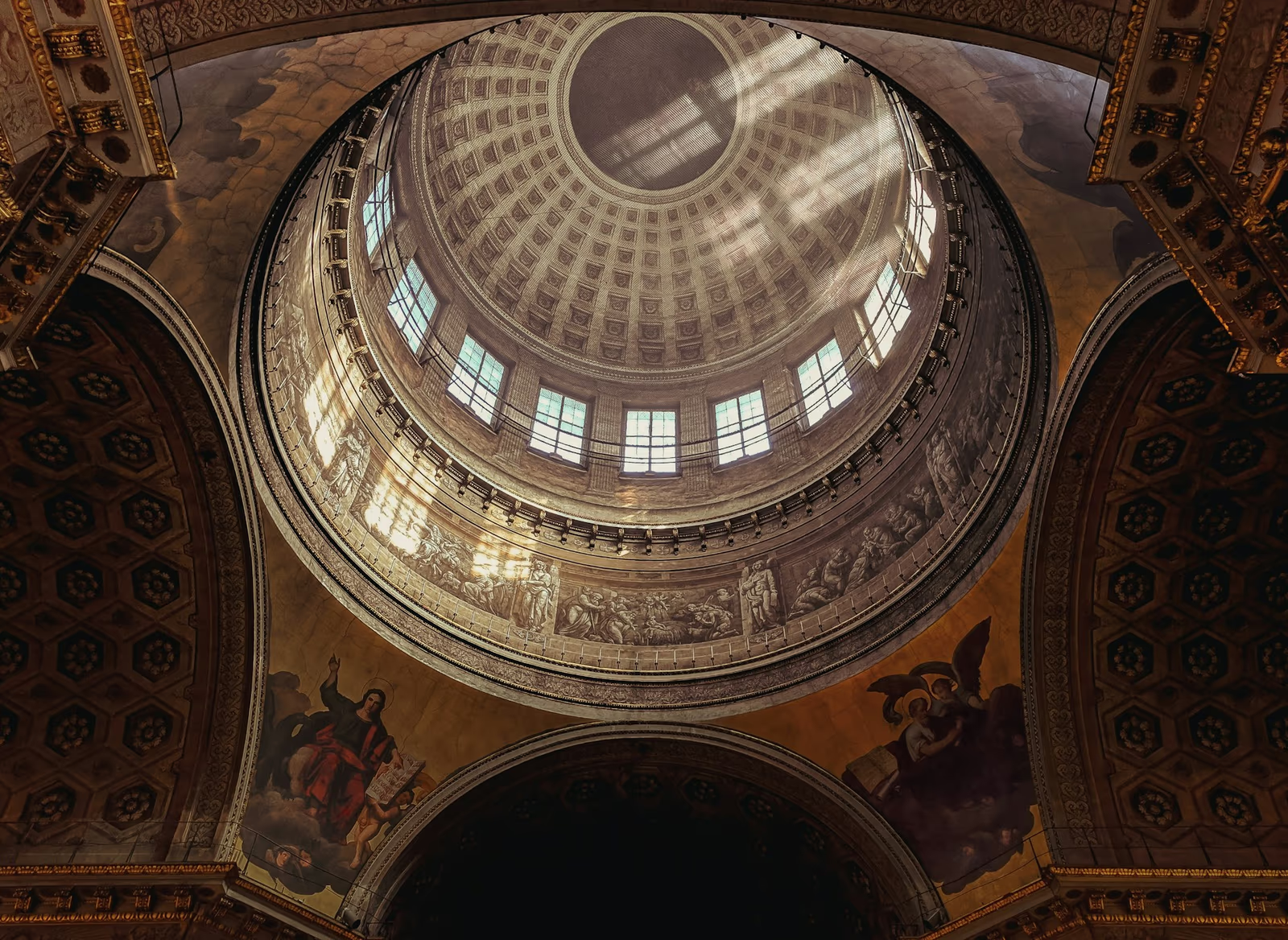
The bankers' money turned into pigment, into marble, into domes. Donatello, Botticelli, Brunelleschi — all worked in this golden climate of wealth and ambition. Above the rooftops of Florence rose the boldest structure of the age: Filippo Brunelleschi's colossal cathedral dome, raised without a supporting scaffold, a proof in stone that mankind now dared what had once been left to God alone.
So a city of trade became a workshop of genius. And into its streets, from a village nearby, came a young man who would embody the versatility of the age like no other.
A Glimpse into Leonardo's Notebooks
Anyone who wishes to grasp the spirit of the Renaissance with their own hands must open the notebooks of Leonardo da Vinci. And then pause. For the writing runs the wrong way.
Leonardo wrote in mirror script — from right to left, every letter reversed. To read his lines you must hold the page up to a mirror. Scholars still puzzle over his reasons. Some see a secret in it, a shield against prying eyes. The likelier explanation is plainer: Leonardo was left-handed, called mancino by his contemporaries. A left-hander writing from right to left does not smear the fresh ink.
Yet the pages remain a riddle. Tens of thousands survive, scattered across volumes such as the Codex Atlanticus and the Codex Arundel. And on a single sheet a whirl of ideas crowds together as no orderly science would allow: the eddies of flowing water beside the anatomy of the human heart, a flying machine beside a costume sketch, cogwheels beside the study of a child's face.
Here is what the age understood by a great mind: not the specialist, but the universal genius. Painter and engineer, anatomist and inventor in one person. Leonardo drew no line between art and science — for him both were the same gaze upon the same world, led by the eye and tested by the hand. In his reversed lines lies hidden the self-image of an entire era.
A New View of the Human Being
What Leonardo lived, scholars had long since raised to a programme. They called it humanism — and it began not with formulas, but with old books.
As early as the fourteenth century, the poet Francesco Petrarch ransacked the libraries of monasteries for forgotten manuscripts of antiquity. What he and his successors found altered the way people saw the world. No longer did the question of God alone stand at the centre, but the studia humanitatis — the study of what makes us human: our language, our history, our dignity, our capacity for reason and beauty.
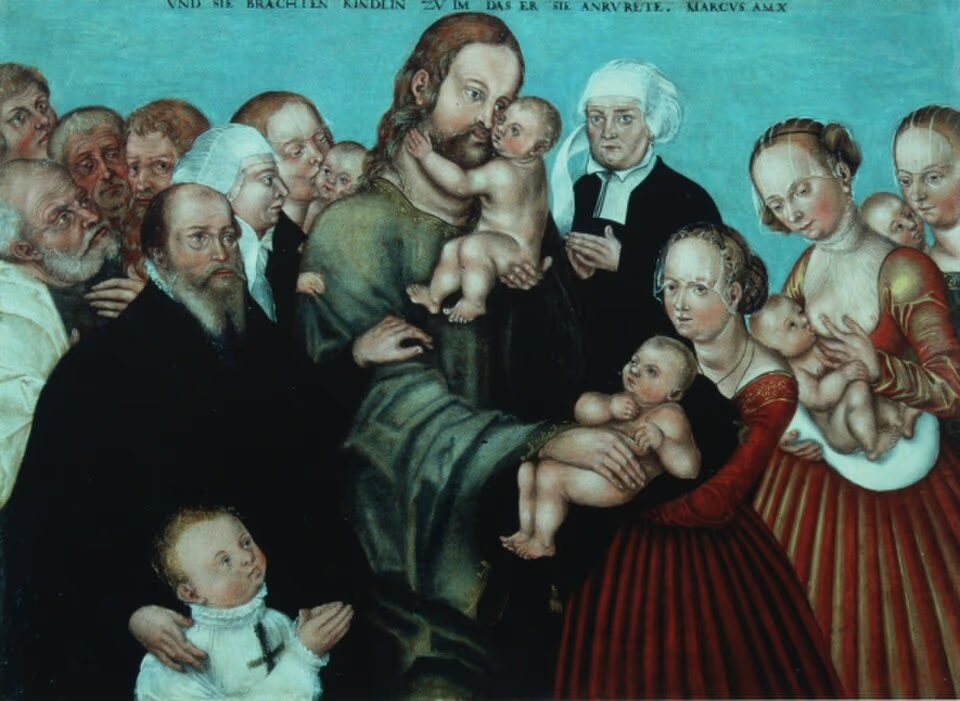
It was a quiet revolution. Where the Middle Ages had seen the human being chiefly as a sinful creature before its Maker, the Renaissance moved the human into the middle of the picture — as a thinking, making, wondering being. Man did not replace God, but he did become the measure of things, an object of his own admiration.
This idea was carried outward by an invention that accelerated everything: printing with movable type. What once had to be laboriously copied by hand could now be multiplied a thousandfold. Ideas travelled across the Alps and through the cities faster than ever before. A thought conceived in Florence could be read within years in Antwerp, Nuremberg or Oxford. For the first time, knowledge became a movement.
The End of the Epoch
Every rebirth has its limit. Around 1600 the particular brilliance of the Renaissance fades, and its achievements pass into the broader current of the modern age — flowing on, without a sharp break.
Yet one fault line ran straight through the age. When Martin Luther aimed his theses against the sale of indulgences in 1517, the Reformation caught fire — and with it a rupture that would shape Europe for centuries. The humanist delight in reading old texts critically had prepared the ground; now that scrutinising gaze turned against the Church itself. The unity of faith shattered.
So the Renaissance ends not with a thunderclap but branches outward: into wars of religion and scientific curiosity, into a world grown larger and more restless. The epoch of transition had done its work — it had prised open the medieval order and let the modern age pass through.
Anyone walking through Florence today still feels it: in the dome above the cathedral, in the frescoes of the chapels, in the eyes of the painted faces that regard us across five centuries as if they knew something. The Renaissance bequeathed us the idea that a single human being can measure the world anew — with the brush, with the pen, with the compass. It is an idea that has never quite let us go.
Test Your Knowledge
Can you guess the historical epoch from four clues? A new puzzle every day — free to play.
Sources: Renaissance, Britannica (britannica.com) · Renaissance Humanism, World History Encyclopedia (worldhistory.org) · Leonardo da Vinci's notebooks, Victoria and Albert Museum (vam.ac.uk) · House of Medici, Wikipedia (en.wikipedia.org) · Renaissance – Das Menschenbild, Planet Wissen (planet-wissen.de)