Period: c. 1500 – 1800 CE
Sugar, porcelain, coffee — things no one in Europe had heard of before 1500 became ordinary within two centuries. The real price was never written on the bill of lading.
The World Becomes a Counting House
The early modern age opens with two tremors: faith splits apart in a German town, and ships come home from the far side of the earth. Yet what grew out of those beginnings was settled neither from pulpits nor on the decks of caravels. It was settled in counting houses — the cramped, paper-choked rooms where merchants kept their figures.
Voyages were ruinously expensive. A fleet bound for Asia swallowed a fortune and might never be seen again. No single merchant, no single prince cared to shoulder that alone. So something was devised that had not existed before: a way to cut risk into pieces and pass the pieces on.
Out of that plain necessity grew an order that shaped three centuries — and whose outlines are not at all strange to us.
Amsterdam, 1602 — The Invention of the Share
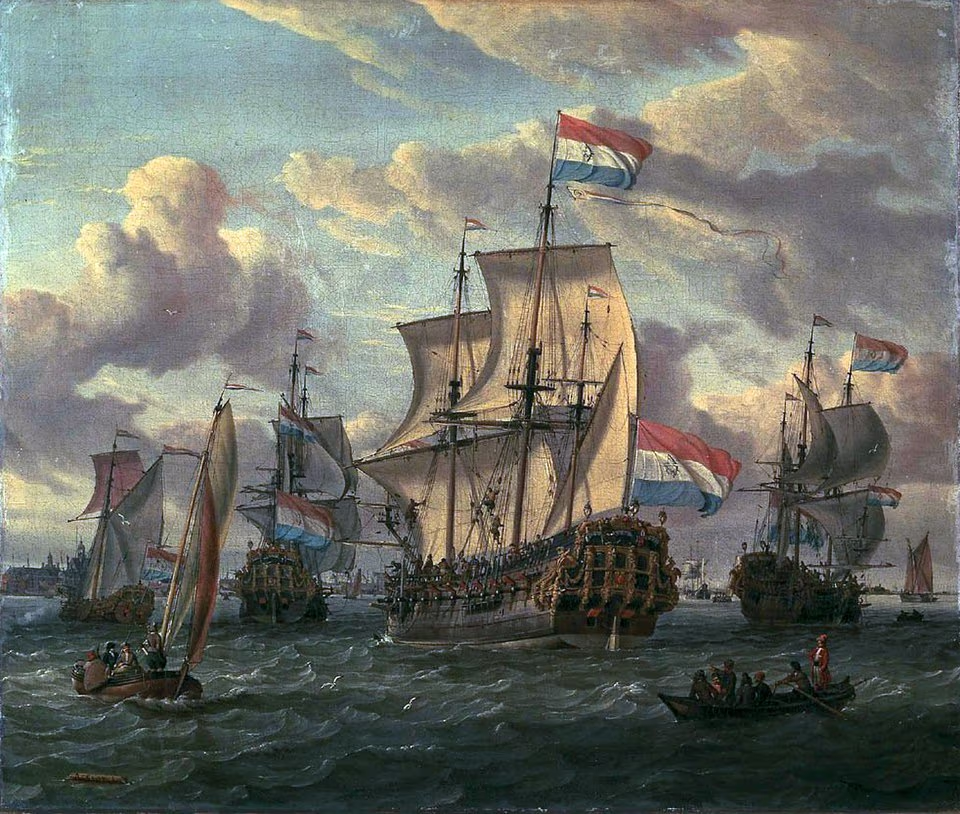
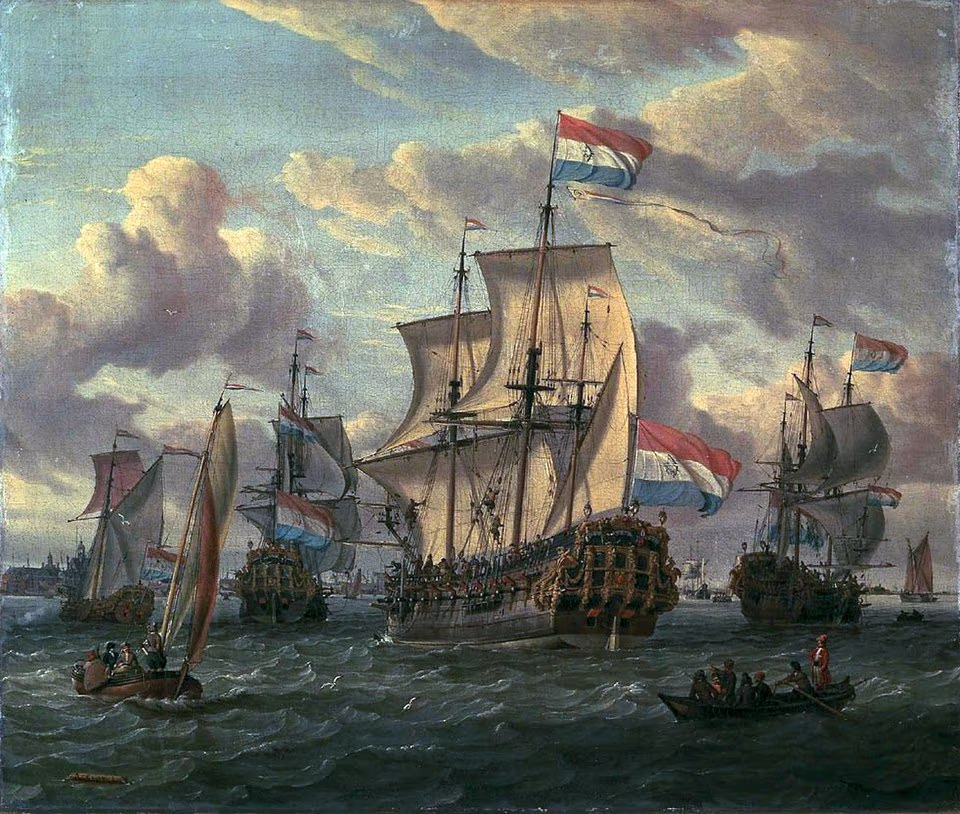
In the spring of 1602 the rival Dutch trading ventures were folded into one. The States General handed the new body a monopoly on the Asian trade, along with powers normally reserved to governments: to treat with foreign rulers, raise fortifications, wage war.
The true novelty lay elsewhere. The company threw its capital open to anyone. That August more than a thousand people subscribed — merchants, certainly, but also artisans and serving women. And their holdings did not sit still. A share could be sold on, to anybody, at whatever price a buyer would meet.
Along the Rokin, an Amsterdam canal, this became a daily market within a few years. What changed hands was no longer pepper but the promise of pepper still at sea. Forward contracts, options, short sales — the machinery of modern finance was rehearsed here long before anyone had names for any of it.
Buy a share today and you are using something invented on that canal.
The Fever and the Reckoning
Where prices float freely, fever follows. This one arrived as a flower.
The tulip had come out of the East, and in the gardens of the wealthy it signalled rank. Bulbs with flamed and feathered petals were prized above all — a freak of nature, as we now know the work of a virus. Between 1634 and 1637 prices climbed past sense. A single bulb of the most famous variety could cost as much as a canal house in Amsterdam.
None of this happened on the exchange. It happened in taverns, and what changed hands was usually not a bulb at all but a claim on a harvest not yet lifted. Contemporaries called it the wind trade. In February 1637 the customary auctions were held and, for the first time, no buyers came. Within days the market was a corpse.
Later ages turned the episode into a fable and probably overdrew it. Still, something in it holds: a society had learned to trade in expectations. Expectations can simply stop.
White Gold, Sweet Poison
The ships brought back things for which there were no words.
There was porcelain. Chinese wares reached the Netherlands from the early seventeenth century in such quantity that they sit unremarked on the tables of Dutch paintings. European potters strained to copy them. In Delft they coated ordinary earthenware in white tin glaze and painted it blue — an imitation that became an art in its own right, because the essential ingredient was missing. Only in 1710 did a Saxon manufactory achieve true hard-paste porcelain, guarded thereafter like an affair of state.
And there was sugar. Before 1500 it belonged in the apothecary; now it became a bulk commodity — and the darkest matter of the age. The plantation system took shape on the Atlantic islands, moved to Brazil, and from there into the Caribbean. It demanded labour on a scale no willing migration could supply. Roughly two-thirds of all people carried across the Atlantic in bondage ended in the sugar colonies; the traffic reached its height in the 1780s.
The wealth that filled Europe's counting houses was, in no small measure, extracted from lives that had no say in the matter. To tell this age only as one of discovery is to tell half of it.
The Coffee House Where the News Lived
In 1652 the first coffee house in London opened in a narrow alley off Cornhill. Twenty years on there were dozens. A penny bought a dish of coffee and something harder to come by: admission.
They were called penny universities, and with reason. Merchants, physicians, scholars and idlers sat at one table, and a man was heard for his argument rather than his birth. Newspapers lay about, along with shipping lists and rates of exchange. Members of the young Royal Society gathered in them. Some of these rooms hardened into insurance houses, others into exchanges.
It is no accident that the Enlightenment found its quarters here. An age that set reason above rank needed somewhere the two could rub against each other daily.
How the Age Ended
No single date closes the early modern period, but it has a symbol. In 1789 an order that had believed itself ordained by God collapsed in Paris. The ideas that undid it had ripened in salons and in precisely those coffee houses.
A quieter upheaval was already under way. In English workshops, steam began to do what muscle and waterwheel had done before. The commerce that had laced the world together acquired an engine — and with that, another age began.
A lump of sugar in the cup, a white plate, a share in a company: three things no one looks at twice. All three are inheritances from a time when Europe declared the world a marketplace — with everything that meant, in ingenuity and in guilt.
Can you tell the epochs apart? Play today's puzzle
Sources: Dutch East India Company, worldhistory.org · Life on a Colonial Sugar Plantation, worldhistory.org · Transatlantic slave trade, britannica.com · English Coffeehouses – Penny Universities, historic-uk.com · Chinese porcelain, delftsaardewerk.nl · Kraak ware, en.wikipedia.org