Period: c. 1400 – 1600 CE
The great pictures were not born of a genius's lightning. They were born of the workshop — the smell of linseed oil, the grind of stone on the slab, the wait for a blue that came from beyond the sea.
An Age of Transition
"Rebirth" — later scholars gave that name to an age that had no name for itself. What was reborn was antiquity: its forms, its proportions, its faith in the human being. Yet the Renaissance is no clean line on the calendar. It lies across two worlds. When it woke in the cities of Italy, the medieval age had not ended and the modern had not begun. For roughly two centuries — from about 1400 to 1600 — it overlaps them both.
To understand it, do not begin with the famous names. Begin with the rooms where the pictures were made. For behind every altarpiece, every princely portrait, every painted Madonna stood not a solitary creator but an enterprise: the bottega, the workshop.
Florence — Guilds, Workshops and Contracts
Why Florence? The city on the Arno was rich, ambitious and tightly packed. Its wealth came from wool, from cloth, above all from money — Florentine bankers lent to the courts of Europe. Those who had money wanted standing, and standing was bought in stone and colour.
But a painter in this world was no free artist. He was a craftsman among craftsmen. To keep a workshop in Florence he had to belong to a guild — and painters belonged, of all things, to the Arte dei Medici e Speziali, the guild of physicians and apothecaries. The reason is telling: their colours were powders, traded like medicine and saffron, ground from stones, earths and dried insects.
In the bottega a single master ruled a dozen hands. A boy entered at nine or ten and began at the bottom: cleaning brushes, priming panels, grinding pigment until his arms ached. Only after years was he trusted with the hem of a robe, then a face, at last perhaps a whole figure in the master's manner. From the workshop of Andrea del Verrocchio came Botticelli, Perugino and a left-handed boy from Vinci. Under Lorenzo Ghiberti trained Donatello and Paolo Uccello. Art was not a flash of the mind. It was a trade one served.
And it was a business. What was to be painted was set down in a contract: dimensions, dates, the number of figures — and the quantity of the costliest pigment.
A Blue More Precious Than Gold
For one colour was so valuable that it was priced in the contract itself: ultramarine, the deep and glowing blue. Its very name says where it came from — ultra marinus, "from beyond the sea." It was won from lapis lazuli, a stone that caravans carried out of the mountains of the distant East to Venice, and from there into the workshops of Italy.
Turning the stone into colour was a secret craft. The lapis was crushed, the powder kneaded for days into wax and resin, the purest pigment washed out in lye. What remained was a small heap of blue that, gram for gram, was worth more than its weight in gold. Small wonder it was kept for the most important passages — above all the mantle of the Virgin. A patron who paid for ultramarine did not buy blue. He bought devotion, rank and eternity.
How such colours were ground, bound and laid down was told in a slim book: the Libro dell'Arte of Cennino Cennini, the first treatise on art written in Italian, set down around 1400 — a handbook of technique and recipe, half workshop, half alchemy.
At the same time the North kept a different secret. In the Low Countries, Jan van Eyck drove oil painting to an unheard-of depth: thin, translucent layers that threw the light back from within. His Ghent Altarpiece of 1432 shone as though built from gemstones. The technique travelled south across the Alps. That van Eyck "invented" oil is a fine legend — spread, much later, by a Florentine who was the first to write the history of art.
From Craftsman to Genius
For something shifted across these centuries, and it was more than a way of mixing paint. The human being moved to the centre. The humanists read the ancient texts anew and recovered a confidence the medieval world had never known: that a person might be beautiful, capable, turned toward the world rather than away from it.
The workshop felt it too. The painter — yesterday a guild artisan with colour crusted beneath his nails — began to think of himself as a mind. Leon Battista Alberti wrote a theory of painting and declared it a matter of the intellect, not the hand alone. The left-handed boy from Vinci filled his notebooks with muscles, machines and the coiling of water — writing them backwards, right to left, as if to keep them from prying eyes.
And at last a painter named Giorgio Vasari gathered the lives of his fellow craftsmen and turned artisans into heroes. His Lives created a figure that had never quite existed before: the artist as a single, unmistakable genius. To this day we see the Renaissance through his eyes.
The End of the Epoch
Yet every age has its dusk. By 1600 the clear order of the early Renaissance had worn thin. A younger generation bent its perfect forms into the strained, the elongated, the restless — later called Mannerism.
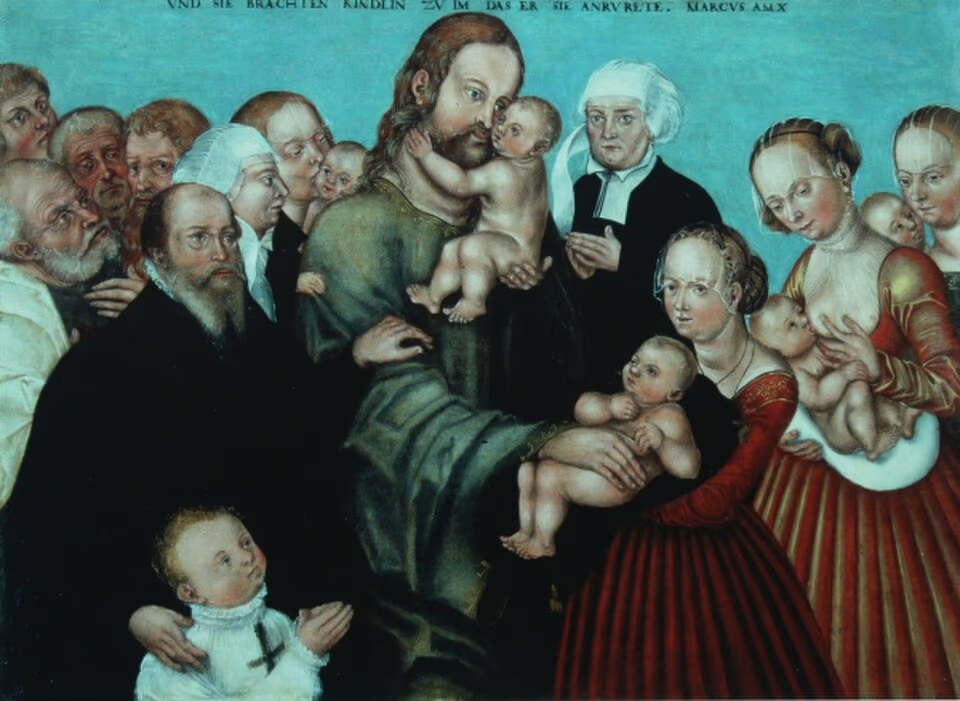
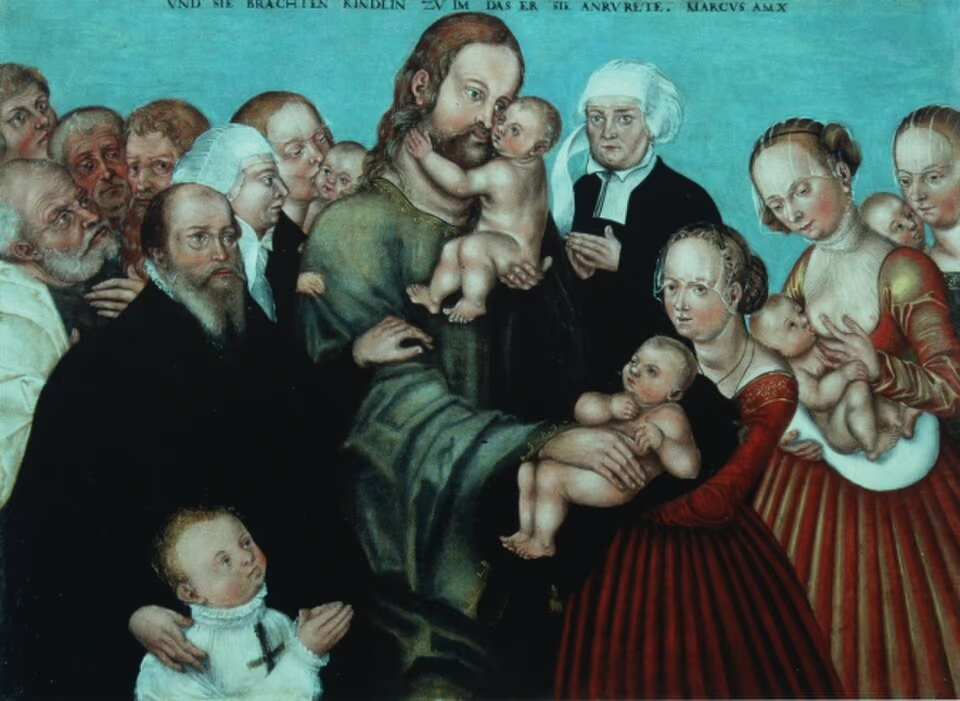
At the same time a deeper rupture tore through Europe. The Reformation split Christendom, and with it the world of images: in the North the altars fell silent, while in the Catholic South they grew only more magnificent. The workshops laboured on, but the world around them had changed. The age of rebirth became, almost imperceptibly, the modern age.
Test Your Knowledge
Can you guess the historical epoch from four clues? A new puzzle every day — free to play.
Sources: Cennino Cennini, Il Libro dell'Arte (c. 1400) · Giorgio Vasari, Lives of the Artists (1550) · Life in a Renaissance Artist's Workshop, World History Encyclopedia (worldhistory.org) · Jan van Eyck, Britannica (britannica.com) · Ultramarine / Lapis lazuli, Wikipedia (en.wikipedia.org)