Period: c. 800 BC – 500 AD (the Mediterranean world)
In the beginning there was not the marble, but the voice. A heckle across the marketplace, a law cast into bronze, a curse scratched with a nail into wet plaster. Antiquity is the age in which Europe learned to speak — and never fell silent again.
One Age, Two Civilisations
Thirteen centuries in a single word. Antiquity runs from the first cities of archaic Greece to the last emperor of the Roman West, and across that vast span live two worlds that could hardly differ more: the splintered Greece of the city-states, and the one insatiable Rome.
Why do they belong together? Because they were forever within earshot of each other. Rome conquered Greece with the sword and yielded to it with the ear — taking up the gods, the books, the oratory of the defeated. What the Greeks had thought, the Romans went on saying, across half a continent, in a tongue that would endure. The thread binding this world was not an empire but a sea: the Mediterranean, which the Romans simply called mare nostrum, our sea. Across its waves travelled goods, armies — and words.
Greece — The Invention of the Argument
At the beginning stands no emperor, but a babble of voices. Hundreds of small city-states, the poleis, scattered along broken coastlines, each headstrong, each proud. And out of that disunity grows something that will change the world: the notion that a quarrel might be settled not only with weapons, but with words.
The place for it is the agora, the marketplace at the city's heart. Here goods change hands and reputations are torn to shreds; here the orators gesture, and Socrates presses his awkward questions between the market stalls. Around 507 BC the Athenian Cleisthenes reorders the citizen body — by neighbourhood, not by wealth — and out of his reforms comes a word still echoing today: dēmokratía, rule by the people. A narrow people, to be sure; women, slaves and foreigners stayed shut out. Yet the idea had entered the world: that free citizens, gathered and speaking, might govern themselves.
And when the arguing did fall quiet, it fell quiet at Olympia. From 776 BC the finest of Greece met there every four years in honour of Zeus; the first champion on record is a cook named Coroebus. By these games the Greeks would even come to reckon their years — in Olympiads. To speak, to compete, to think: in Athens the word became power, and philosophy became the West's most lasting voice.
Rome — The Word That Became Law
While Greece talks, Rome writes it down. From a settlement on the Tiber grows, over centuries, a power reaching from the Atlantic to the Euphrates. Its instrument is not only the legion, but the letter.
Around 450 BC the Romans do something bold: they set their law in writing and post it in public — the Twelve Tables, displayed in the Forum so that every citizen might know it, and no powerful man bend it at will. It is a quiet, immense moment. The law now belongs no longer to priests and patricians alone, but to anyone who can read. From that kernel grows a legal system that, centuries later, lives on in the law codes of Europe — right into our own courtrooms.
So that the word might travel too, the Romans build roads: in the end some 85,000 kilometres of paved highway, arteries through which armies, merchants and messages flow. "All roads lead to Rome" is not a proverb but geography. Along aqueducts raised from 312 BC onward, water pours into the cities; a few still feed their fountains today. Great names crowd the story — Caesar at the Rubicon, Cicero at the speaker's platform — yet Rome's most enduring legacy stands not in battle reports, but in clauses.
Pompeii — A City Full of Voices
Sometimes history holds its breath. In AD 79 Vesuvius erupts and buries the thriving town of Pompeii beneath metres of ash and pumice. What is the end for its people becomes, for us, a window — and a loud one. For the ash preserved not only houses and bread still in the ovens, but the words on the walls.
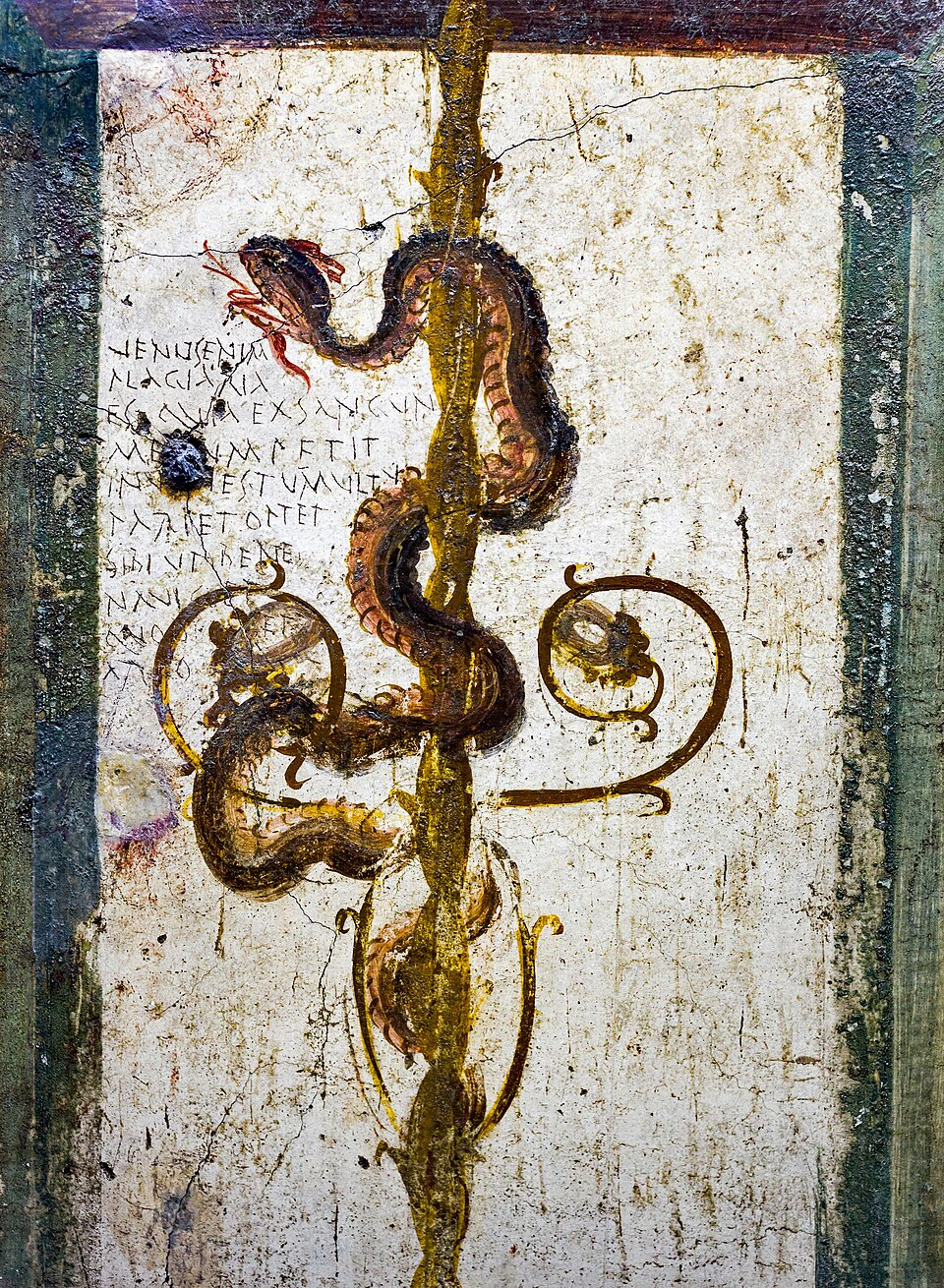
Thousands of inscriptions have come to light: election slogans, market notices, gossip, love vows, insults, scrawled one over another. "Marcus Cerrinius for aedile — some love him, some are loved by him, I can't stand him," one mocks. Another swears: "Love guides my hand, and Cupid steers it." A disgruntled traveller rails at an innkeeper for selling water while keeping the good wine for himself. No royal tomb, no temple — the wholly ordinary voice of the street, frozen at the instant it fell silent. When Pompeii is brought back into the light in the eighteenth century, modern archaeology is born with it. And two thousand years on, we are listening again.
When the Voices Fell Silent
Empires rarely fall with a thunderclap; more often they fade. For centuries border wars, economic hardship and inner decay drain Rome's strength. Germanic peoples press into the provinces, and the centre loses its grip.
The date usually set at the close of antiquity is the year AD 476: the commander Odoacer deposes the last western emperor — a boy bearing the grand name Romulus Augustulus — and sends the imperial insignia to Constantinople. No emperor in the West any longer. Yet the word does not entirely fall silent. Latin becomes the language of the church and of scholars, outlasting in monasteries the centuries in which, around AD 500, the old world dissolves for good into the Middle Ages.
What Still Speaks
And so nothing truly ends. We gather and argue and call it democracy — a Greek word. We appeal to laws whose roots lie in Rome. Our languages carry Latin within them, and anyone who carves a name into a park bench today does no more than the wit on Pompeii's wall.
Antiquity has not fallen silent. It goes on speaking — in every courtroom, every ballot box, every scribbled word. You need only listen.
Test Your Knowledge
Can you guess the historical epoch from four clues? A new puzzle every day — free to play.
Sources: Agora, World History Encyclopedia (worldhistory.org) · Cleisthenes, World History Encyclopedia (worldhistory.org) · Law of the Twelve Tables, Britannica (britannica.com) · Pompeii: Graffiti, Signs & Electoral Notices, World History Encyclopedia (worldhistory.org) · Ancient Olympic Games, Britannica (britannica.com) · Romulus Augustulus, Britannica (britannica.com)